
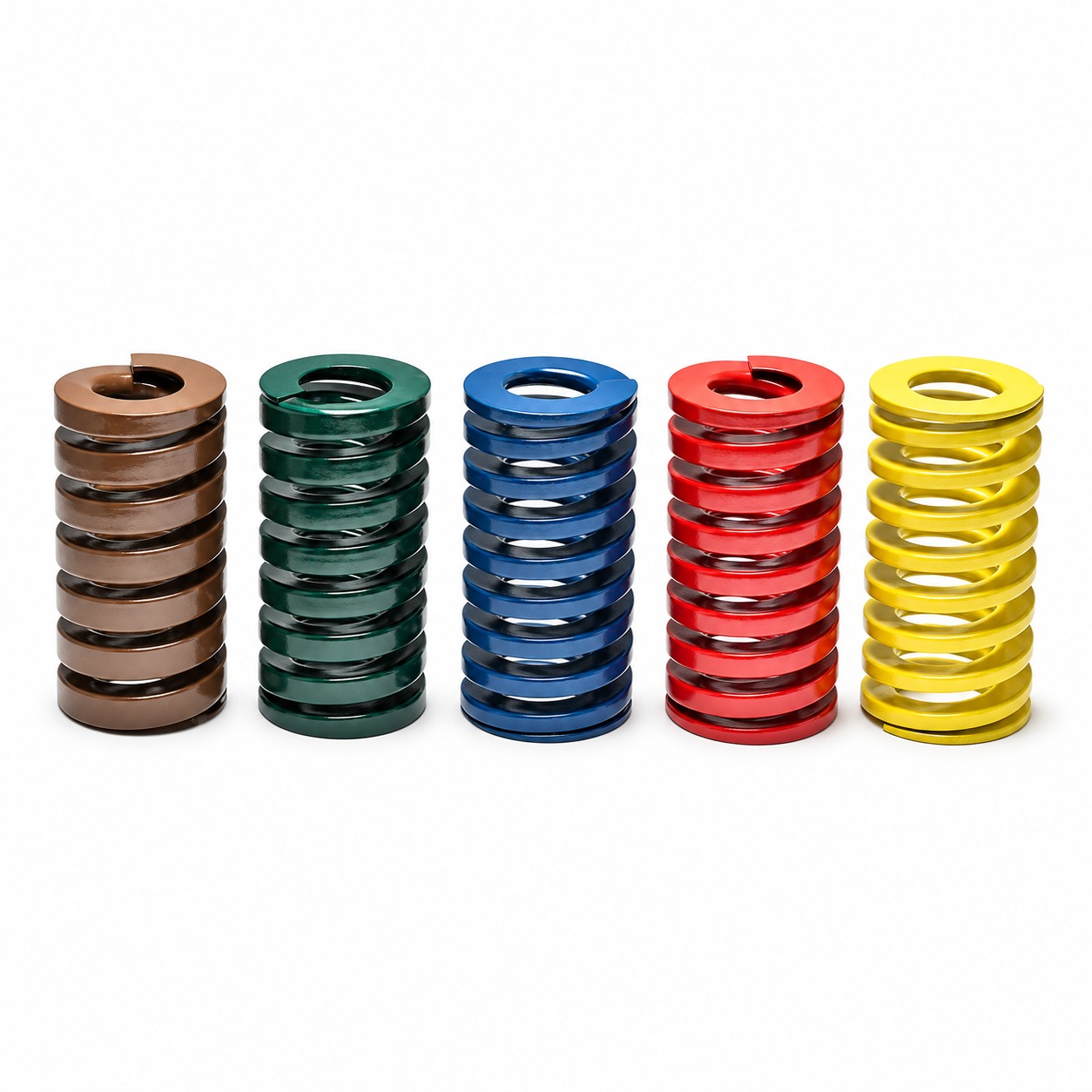
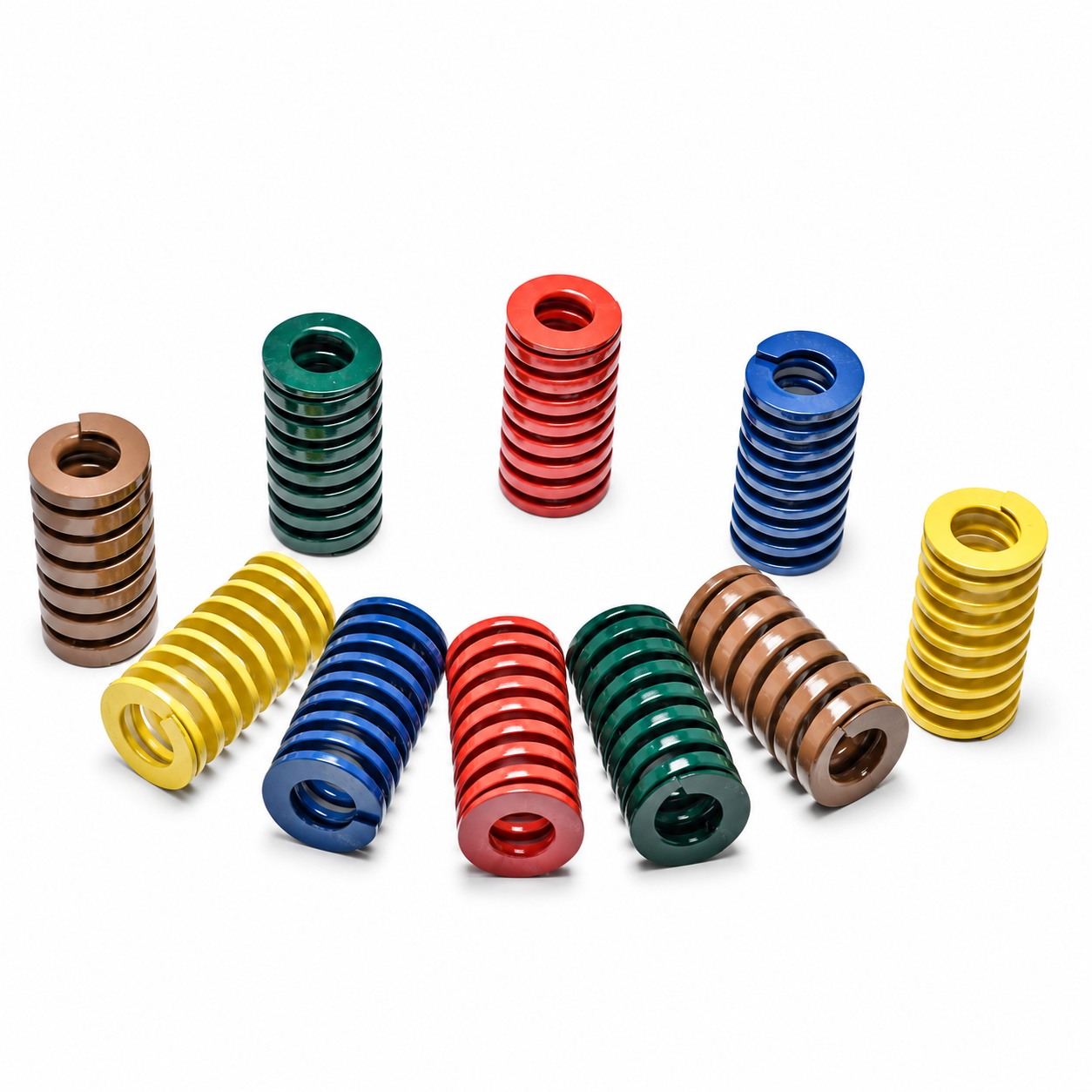
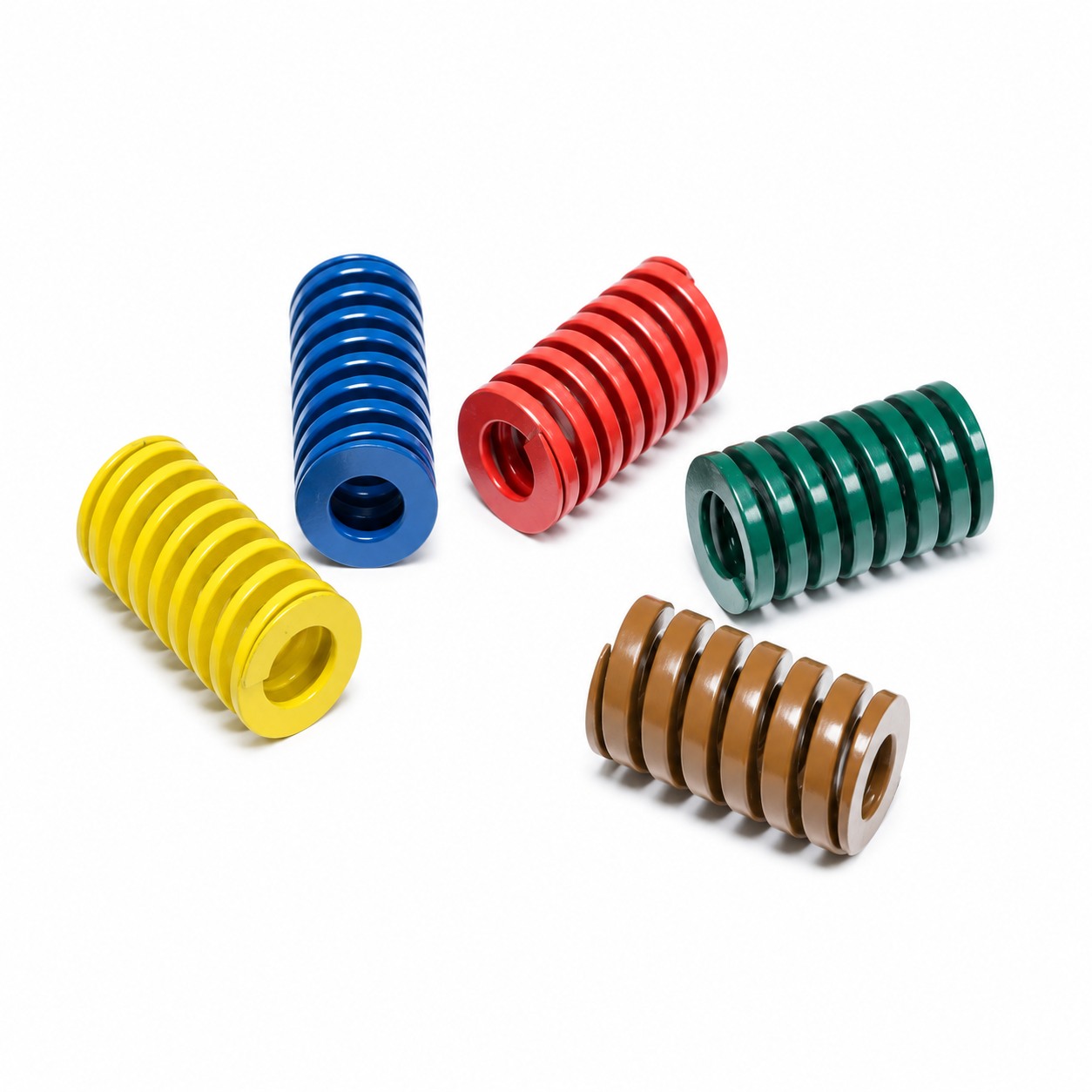
A rectangular wire spring is a helical compression spring wound from wire with a rectangular cross-section. In tooling applications, this construction is commonly associated with die springs, where the available installation space and required compressive force influence spring selection. The term “rectangular” describes the wire section; the finished spring usually has a cylindrical coil form.
For buyers sourcing springs for stamping dies, injection molds or industrial tooling, the key specification is the force required at the installed and fully working positions. Dimensions, spring rate and allowable deflection must be checked together.
Why Choose a Rectangular Wire Compression Spring?
Rectangular wire can make efficient use of a constrained spring envelope. Depending on the wire orientation and design, it can provide greater energy storage within the available space than an equivalent round-wire arrangement. This is useful where the tool design limits the spring pocket or compressed height.
However, wire shape alone does not determine the right spring. A heavy duty rectangular wire compression spring still needs a suitable load–deflection relationship, adequate guidance and enough clearance throughout its travel. Compare the actual part data when evaluating alternatives.
Rectangular Wire Spring Specifications to Confirm Before Ordering
Use the following information to define a spring or check a replacement:
| Specification | What to confirm |
|---|---|
| Spring construction | Rectangular-section wire, helical compression form |
| Free length, L₀ | Unloaded length in mm |
| Installation dimensions | Housing bore and guide rod dimensions, plus actual spring OD and ID where required |
| Spring rate, R | Force increase per millimetre of compression, in N/mm |
| Installed condition | Installed length, preload deflection and initial force |
| Working condition | Additional stroke, final compressed length and required force |
| Deflection limit | Permitted operating compression for the selected part and duty |
| Material and finish | Agreed steel grade, end configuration and coating |
| Operating conditions | Cycle frequency, temperature, environment and target service life |
Catalog symbols vary. In particular, a nominal housing diameter or guide rod diameter is an installation reference and should not automatically be treated as the measured spring outside or inside diameter. Read the dimensional drawing alongside the table.
ISO 10243 Die Spring Load Classes and Colors
ISO 10243 covers rectangular-section compression springs for press tooling, including housing dimensions and color coding. Its classification has four spring-rate groups. It does not establish a universal material grade or service-life guarantee. See the ISO 10243:2019 scope.
Common English catalog labels for these four color groups are:
| Color | Common catalog load label |
|---|---|
| Green | Light |
| Blue | Medium |
| Red | Heavy |
| Yellow | Extra heavy |
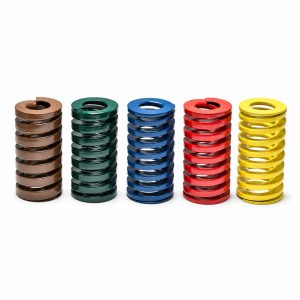
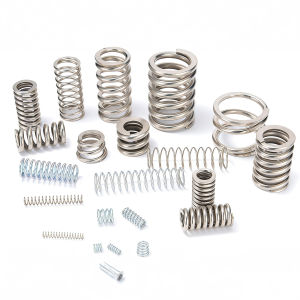
Color helps identify a series, but the part number, dimensions, spring rate and permitted travel still need verification. Suppliers may also offer additional series outside the four-group classification. The product photographs show five finishes; they do not establish an ISO or JIS load classification. Confirm the color-to-load mapping for the quoted product series and check its part data before selecting a replacement.
Applications and Product Configuration
Rectangular wire die springs are used in stamping tools and injection molds to provide compression and return forces. Depending on the tool design, their tasks may include supporting stripper movement or returning moving mold components. Other industrial applications require the same checks of force, available space and repeated travel.
For product configuration, specify the required steel grade, end treatment and surface finish. Where shot peening, ground bearing ends or protective coatings are required, confirm that these features apply to the selected part and request the relevant inspection or performance information. Material grade and operating limits should be agreed against the selected drawing and quotation.
How to Select a Rectangular Wire Spring
Start with the mounting space and the load needed at each operating position. Then work through four checks:
- Confirm the fit. Check the spring pocket, guide rod, free length and minimum installed length against the drawing.
- Include the preload. Add the initial compression to the additional operating stroke when calculating total deflection.
- Compare force and travel. Use the selected part’s load–deflection data to check both the initial and final forces.
- Review the duty. Confirm the permitted deflection for the cycle conditions, guidance, temperature and intended service life.
For an approximately linear spring within its specified working range, a preliminary force estimate is:
F ≈ R × s
Here, F is force in N, R is spring rate in N/mm and s is total compression from the free length in mm.
For an illustrative calculation, assume a 50 mm free length, a 20 N/mm spring rate, 3 mm of preload compression and 7 mm of additional operating stroke. Total compression is 10 mm, or 20% of the free length. The estimated initial force is 60 N, and the estimated final force is 200 N.
These assumed values demonstrate the calculation. They do not identify a suitable catalog part. Check the selected spring’s permitted operating deflection, tolerances and load data before approving the design.
Service life also depends on installation and operating conditions. Preload, guidance, stroke, cycle speed and environment all affect performance. Keep normal operating travel within the specified limit and retain clearance from coil bind.
Frequently Asked Questions
Is every rectangular wire spring an ISO 10243 die spring?
No. Rectangular wire describes the wire cross-section. An ISO 10243 designation requires the relevant product specifications to meet that standard. Custom designs and other catalog series may use rectangular wire with different dimensions or classifications.
Does a heavier load class always make a better replacement?
Select the class that provides the required force within the available stroke and permitted deflection. A different class can change the tool’s force at both installed and working positions. Confirm those values before substitution.
What information is needed for a quotation?
Provide a drawing or existing part number, quantity, mounting dimensions, free and installed lengths, working stroke and required forces. Include the operating conditions and any material, finish or inspection requirements.
Request a Rectangular Wire Spring Quotation
Send your drawing or existing spring specification together with the required quantity and application details. For replacement parts, include the original manufacturer and part number where available. A complete enquiry allows the proposed spring’s dimensions, load data and operating limits to be compared with your tooling requirements before ordering.
Contact Hunt for a quotation with your drawing and operating requirements. You can also compare other compression springs when reviewing the available spring construction.
Reviews
There are no reviews yet.