
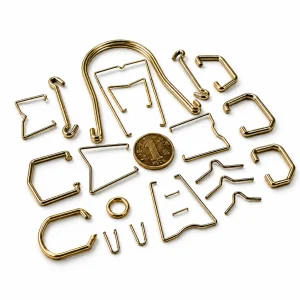
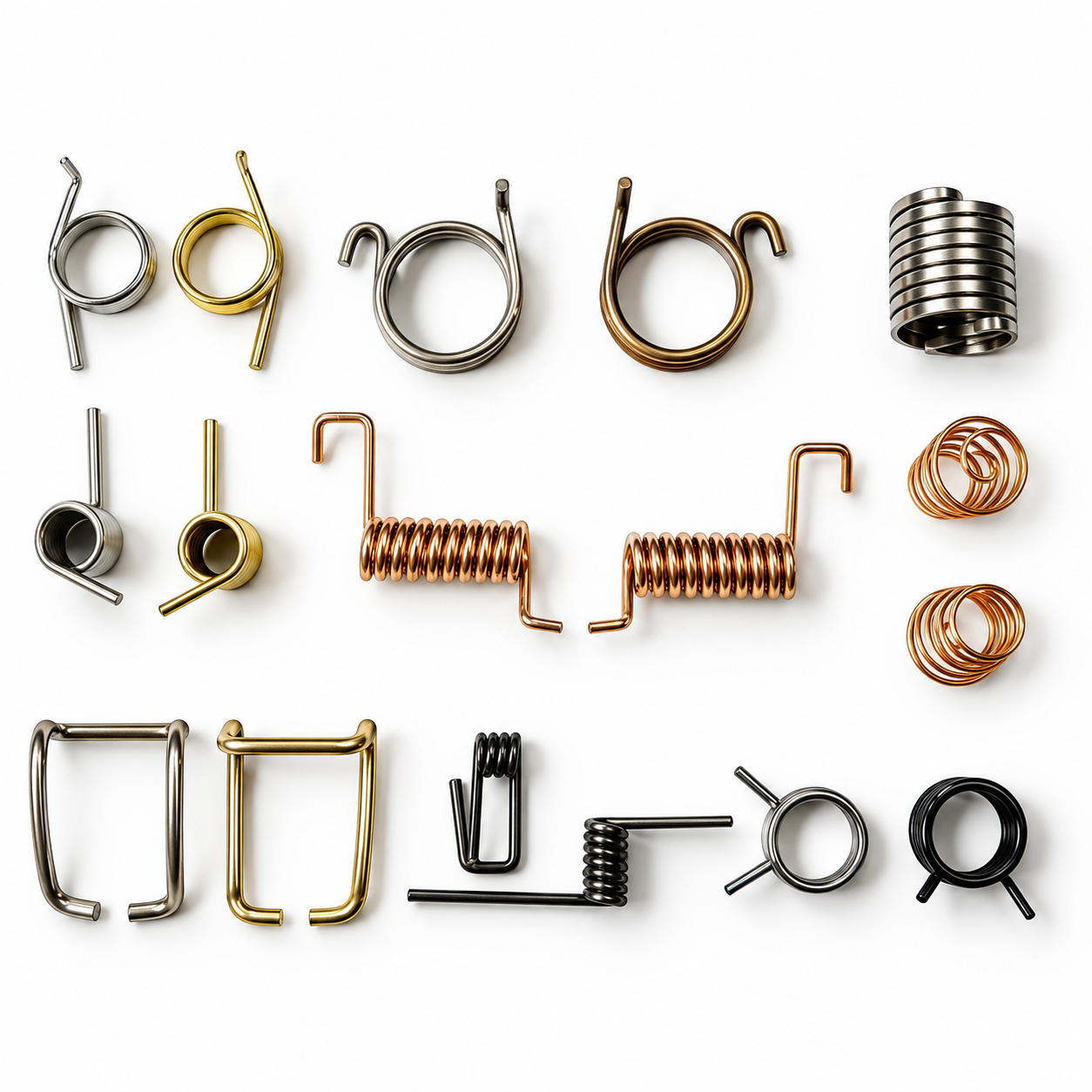
Custom shaped springs are engineered for applications in which a conventional compression, extension, or torsion spring cannot provide the required fit, movement, mounting arrangement, or load response.
Depending on the design, a custom spring may combine a coiled body with straight, hooked, offset, or specially formed legs. Other products may consist primarily of bent wire and are more accurately classified as custom wire forms.
Because these components are made for a specific assembly, their suitability should be determined from a technical drawing, operating requirements, and sample validation rather than appearance alone.
What Are Custom Shaped Springs?
Custom shaped springs are metal spring components formed into application-specific geometries. The term can cover modified torsion springs, unusual coil arrangements, formed wire springs, double-coil designs, clips, retainers, and other elastic wire components.
Wire forms differ slightly from conventional springs. A typical spring contains a helix or group of coils, while a wire form is primarily produced by bending wire to specified angles and lengths.Lee Spring wire-form guide
Some components combine both characteristics. For example, a part may use a coil to create a restoring force while its extended legs are formed to connect with specific mounting points.
Common Custom Spring Configurations
Custom Torsion Springs
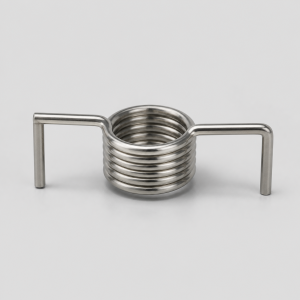
Custom torsion springs use one or more coils to provide resistance against angular movement. Their legs can be straight, offset, hooked, bent, or otherwise formed to engage with the surrounding mechanism.
Important design details include the coil diameter, wire diameter, number of active coils, unloaded leg angle, working angle, torque requirement, and winding direction.
Double Torsion Springs
A double torsion spring normally contains two coil sections connected by a central section. This arrangement can provide a more balanced force distribution when the assembly applies loads at two locations.
The two sides and their mounting positions must be clearly defined in the product drawing.
Formed Wire Springs
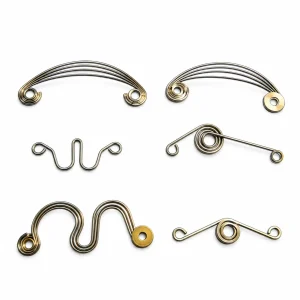
Formed wire springs use bends, curves, loops, and straight sections to create a required mechanical action. They may function as clips, latches, retainers, contacts, or return elements.
Custom wire forms can use round, flattened, rectangular, or shaped wire, depending on the application and manufacturing process.Lee Spring wire-form information
Special End Configurations
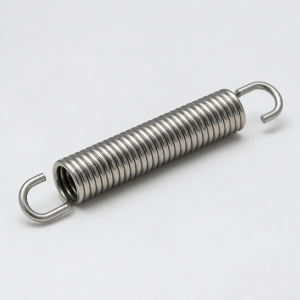
Spring ends can be designed with hooks, loops, straight legs, rectangular bends, offsets, or other attachment features. These details determine how the component interfaces with pins, shafts, housings, and moving parts.
End geometry should always be specified in a dimensioned drawing. A photograph is useful for reference but does not define tolerances or working positions.
Typical Applications
Custom shaped springs and wire forms may be considered for:
- Hinges and cover mechanisms
- Levers and return mechanisms
- Clips, locks, and latches
- Electronic-device assemblies
- Automotive interior mechanisms
- Household appliances
- Industrial controls
- Medical and laboratory equipment
- Furniture and hardware products
- Mechanical positioning systems
The final design depends on the required movement, load direction, available space, operating environment, and expected service conditions.
Product suitability should therefore be assessed for each assembly. A spring designed for one hinge or latch should not be assumed to fit another mechanism with a similar appearance.
Material Selection
Common spring and wire-form material families include carbon spring steel, stainless steel, and copper alloys. Other alloys may be considered for specialized environments.
Material selection should account for:
- Required strength and elastic behavior
- Corrosion exposure
- Operating temperature
- Electrical conductivity, if relevant
- Magnetic requirements
- Surface finish
- Applicable regulatory or documentation requirements
Surface treatments can be selected for corrosion protection, appearance, wear behavior, cleanliness, or other application needs. The exact material and finish must be confirmed through technical documentation.
The silver, gold, copper-colored, and black finishes shown in the product image describe visible appearance only. Color cannot reliably identify the underlying material or coating.
Specifications Required for a Custom Spring
A complete request for quotation should include both dimensional and functional information.
| Specification | Information to provide |
|---|---|
| Component geometry | Dimensioned drawing, CAD file, sketch, or reference sample |
| Wire dimensions | Diameter, width, thickness, or cross-sectional shape |
| Coil dimensions | Inside diameter, outside diameter, body length, and coil count |
| End configuration | Leg lengths, bends, hooks, loops, and offsets |
| Working movement | Compression, extension, rotation, or deflection range |
| Force requirement | Load or torque at defined operating positions |
| Installation space | Maximum envelope and surrounding clearances |
| Material | Required grade or approved material alternatives |
| Surface treatment | Plating, passivation, coating, cleaning, or other finish |
| Tolerances | Critical dimensions and acceptable variation |
| Quantity | Prototype quantity and estimated production demand |
| Validation | Inspection method and functional acceptance criteria |
Industry quotation forms commonly request information such as spring type, material, wire size, outside diameter, free length, coil count, finish, and quantity.Lee Spring quotation checklist
From Drawing to Sample Approval
The development process should begin with the function of the component rather than its shape alone.
First, identify how the part is mounted and what movement it must produce or resist. Define the required force or torque at specific positions and document the space available inside the assembly.
A supplier can then evaluate the geometry, material, forming process, and manufacturing feasibility. CNC wire-forming technology can make prototyping and dimensional revisions more practical for complex parts, although actual capability depends on the supplier and design.Lee Spring manufacturing overview
Before production approval, samples should be checked for:
- Critical dimensions
- Installation fit
- Interference during movement
- Force or torque at specified positions
- Permanent deformation
- Surface condition
- Functional consistency
- Packaging and handling requirements
For repeated-motion applications, establish the cycling conditions and acceptance limits before testing. A service-life claim should be supported by a documented test performed under relevant conditions.
Custom Shaped Springs Versus Standard Springs
A standard spring can be appropriate when its dimensions and performance already match the application. It may simplify sourcing and reduce development work.
A custom shaped spring becomes useful when the assembly requires a particular mounting geometry, limited installation space, unusual movement, special end features, or a defined force profile that standard products cannot provide.
The decision should consider total assembly performance, testing requirements, tooling, production quantity, and future replacement needs.
Frequently Asked Questions
Can a custom spring be produced from a physical sample?
A sample can help identify the geometry, but a drawing and functional requirements are still recommended. A used spring may have permanent deformation or wear and may no longer represent the original specification.
What information is needed to reproduce a custom shaped spring?
Provide the dimensions, material, surface treatment, mounting arrangement, working movement, force or torque requirements, tolerances, and order quantity.
Are all formed wire parts considered springs?
No. Some wire forms provide elastic force, while others function mainly as clips, retainers, hooks, or structural components. Classification depends on the part’s mechanical function.
Can the material be identified from a photograph?
No. A photograph can show visible color, shape, and surface appearance, but it cannot reliably confirm the material grade or coating specification.
Request Custom Shaped Springs
When requesting custom shaped springs, provide a technical drawing, CAD model, sketch, or physical sample together with the component’s functional requirements.
Include the required material, working movement, load or torque, critical tolerances, surface treatment, sample quantity, and expected production demand. Clear specifications help the supplier evaluate feasibility and prepare relevant samples for approval.
Reviews
There are no reviews yet.