
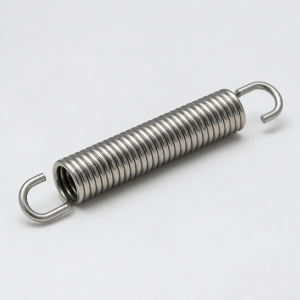
Extension springs, also known as tension springs, are designed to resist pulling forces. They are normally connected to two components by hooks, loops, eyes, or other end features.
When the connected components move apart, the spring extends, stores energy, and produces a force that attempts to return them toward their original position. Selecting an extension spring requires matching its dimensions, initial tension, spring rate, maximum working length, and end configuration to the application.
How Do Extension Springs Work?
Most extension springs are close-wound, meaning that their coils touch in the unloaded position. Tension created during manufacturing holds the coils together until enough force is applied to begin separating them.
This built-in force is called initial tension. It determines the minimum pulling force required before the spring body starts to extend.Lee Spring extension spring guide
After the initial tension has been overcome, the load generally increases with spring deflection within the spring’s intended working range:
Total load = Initial tension + (Deflection × Spring rate)
The actual operating load and safe extension should be confirmed from the product specification or application-specific testing.
Common Extension Spring End Types
The spring body is only one part of an extension spring design. Its hooks and loops connect the spring to the assembly and often experience concentrated stress.
Machine Hooks
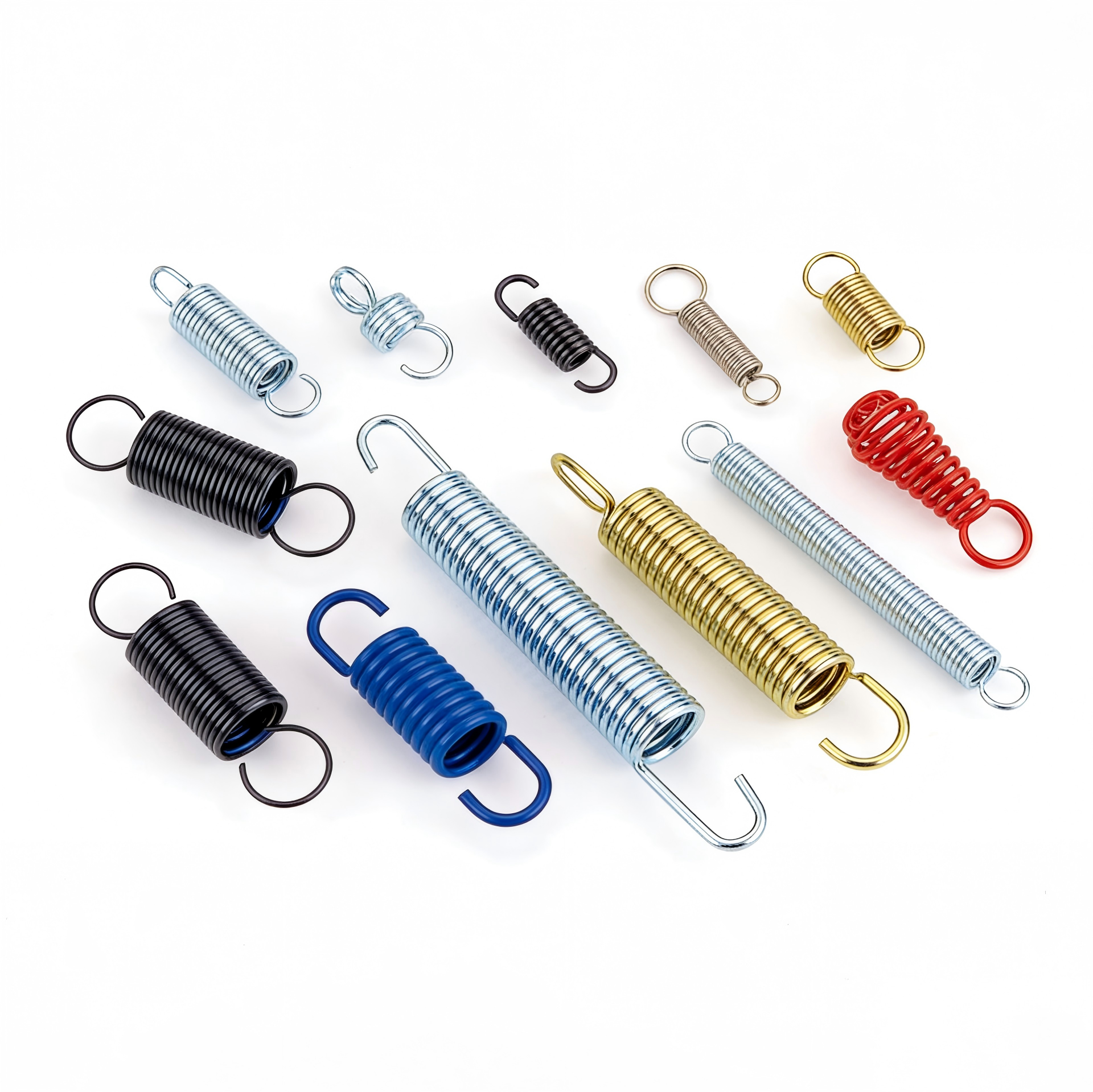
Machine hooks are formed from the end coils and provide an open attachment point. They are common in applications where the spring needs to be installed over a pin, hole, or bracket.
Full Loops
Full loops provide a more enclosed mounting feature than an open hook. Loop diameter, opening size, orientation, and alignment should be checked against the mating component.
Extended Hooks
Extended hooks increase the distance between the coil body and the attachment point. They can help accommodate surrounding components or a specific installation envelope.
Side and Crossover Loops
Side loops and crossover-center loops position the attachment relative to the spring axis in different ways. The correct design depends on the direction of the applied load and the layout of the assembly.
Custom End Configurations
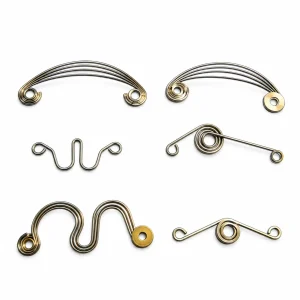
Custom extension springs can use rectangular ends, teardrop ends, expanded eyes, reduced eyes, threaded inserts, swivel fittings, or application-specific wire forms.Lee Spring end-configuration overview
A dimensioned drawing should define the complete end geometry. Terms such as “hook end” or “loop end” alone may not provide enough information for manufacturing or replacement.
Typical Extension Spring Applications
Extension springs are used in mechanisms that require pulling resistance, tension, or return movement. Potential applications include:
- Latches and locking mechanisms
- Hinges and covers
- Automotive interior mechanisms
- Industrial machinery
- Agricultural equipment
- Household appliances
- Garage-door assemblies
- Toys and recreational equipment
- Electronic-device mechanisms
- Maintenance and repair assemblies
Application names alone do not establish compatibility. Two springs used in similar products can have different loads, travel limits, hook geometry, or environmental requirements.
Key Extension Spring Specifications
A suitable extension spring should be selected using both dimensional and functional requirements.
| Specification | What to define |
|---|---|
| Wire diameter | Nominal wire size and tolerance |
| Outside diameter | Maximum spring-body diameter |
| Inside diameter | Clearance for any internal component |
| Body length | Length of the coiled section |
| Free length | Unloaded length measured between specified end points |
| Extended length | Maximum permitted working length |
| Initial tension | Force required to begin separating the coils |
| Spring rate | Change in load per unit of extension |
| Working load | Required force at specified operating positions |
| End configuration | Hook, loop, eye, insert, or custom geometry |
| End orientation | Inline, angled, or otherwise specified |
| Material and finish | Required grade and surface treatment |
| Quantity | Prototype and expected production quantities |
The free length of an extension spring is generally measured between the inside edges of its end hooks or loops. If the end opening or orientation affects assembly, these details should also appear on the drawing.Lee Spring measurement guide
Initial Tension and Spring Rate
Initial tension and spring rate perform different functions.
Initial tension holds the coils together before extension begins. Spring rate describes how much the load changes as the spring extends after that initial force has been overcome.
For example, two springs can have similar dimensions but behave differently because they have different initial tensions or spring rates. Both values should therefore be specified when predictable operating force is required.
The spring should not be stretched beyond its approved working length simply because it can physically extend farther. Excessive extension can cause permanent deformation or damage the end connections.
Material and Surface-Finish Selection
Common material families for extension springs include carbon spring steel and stainless steel. Other alloys may be considered when the application has specific requirements.
Material selection should account for:
- Required load and deflection
- Operating temperature
- Corrosion exposure
- Expected cycling
- Magnetic requirements
- Electrical properties, when relevant
- Regulatory and documentation requirements
Surface treatments may be used for corrosion protection, appearance, cleanliness, identification, or wear considerations.
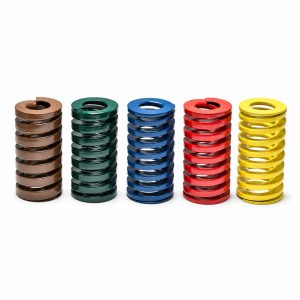
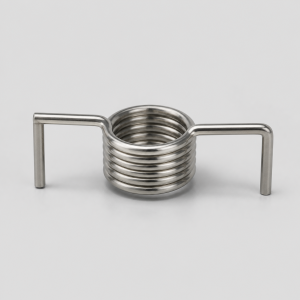
The silver, black, gold, blue, and red products shown in the image have different visible finishes. Their colors do not confirm the underlying material or coating process.
Why Hooks and Loops Require Attention
The transition between the spring body and its hook or loop can be a highly stressed area. In some designs, end stresses may be higher than stresses in the main coil body.
For that reason, end geometry, bend radius, alignment, mounting-pin size, and load direction should be evaluated carefully. Overloaded extension springs may fail at an end connection before the spring body fails.MW Components extension spring selection guide
The mating component should also avoid sharp edges that could damage the spring or concentrate force at a small contact area.
Evaluating an Extension Spring Sample
Before approving a spring for production, evaluate it in the intended assembly or a representative test fixture.
Recommended checks include:
- Wire and coil dimensions
- Free length and end geometry
- Hook or loop orientation
- Initial tension
- Load at specified extended lengths
- Maximum working extension
- Installation clearance
- Permanent deformation after loading
- Surface condition
- Functional cycling under defined conditions
Cycle-life statements should be supported by documented testing that reflects the actual load, travel, speed, temperature, and environment of the application.
Information Needed for a Quotation
Provide the following information when requesting an extension spring:
- Dimensioned drawing, CAD file, sketch, or physical sample
- Wire diameter and coil dimensions
- Free length and maximum working length
- Required load at one or more extended positions
- Initial-tension requirement
- Hook, loop, or end configuration
- End orientation and opening dimensions
- Material and surface finish
- Critical tolerances
- Prototype and production quantities
- Inspection and documentation requirements
If the material is unknown, describe the operating temperature, corrosion exposure, cycle frequency, and other relevant service conditions.
Frequently Asked Questions
What is the difference between an extension spring and a compression spring?
An extension spring resists being pulled apart and normally uses hooks or loops for attachment. A compression spring resists being pushed together along its axis.
Are extension springs and tension springs the same?
The terms are commonly used for the same type of spring. “Extension spring” is the more widely used product-category name in English-language industrial catalogs.
What is initial tension?
Initial tension is the built-in force that holds the coils together. The applied force must exceed this value before the spring body begins to extend.
Can two similar-looking extension springs be interchangeable?
Not necessarily. Wire diameter, coil diameter, free length, initial tension, spring rate, maximum extension, end design, and material should all be verified.
Can an extension spring be copied from a sample?
A sample can help identify its geometry, but a worn or overstretched spring may no longer represent the original dimensions. Functional load requirements should also be supplied.
Request Extension Springs
To evaluate an extension spring requirement, provide a drawing or sample together with the required load, working extension, end configuration, material, finish, tolerances, and quantity.
Confirm the final dimensions and performance through sample inspection and functional testing before approving the spring for production.
Reviews
There are no reviews yet.